
Why Grinding Services Are the Final Step That Defines Precision in Modern Manufacturing
Home
/
Blog
/
Why Grinding Services Are the Final Step That Defines Precision in Modern Manufacturing
Why Grinding Services Are the Final Step That Defines Precision in Modern Manufacturing
May 26, 2026
In precision manufacturing, every machining process builds toward one final objective: achieving exact geometry, perfect surface finish, and functional reliability. While processes like milling and turning create the shape of a part, grinding services define its final performance.
Grinding is often considered the “finishing authority” in manufacturing because it is the process that brings components to their final tolerance, improves surface integrity, and ensures long-term operational stability.
If you are working on high-performance mechanical systems, understanding grinding is not optional—it directly affects durability, wear resistance, and dimensional accuracy.
You can also explore related machining processes here:
👉 CNC Machining Services
👉 CNC Turning Services
👉 Machinist Services
Table of Contents
What Grinding Services Mean in Precision Manufacturing
Grinding services refer to material removal processes that use abrasive wheels instead of traditional cutting tools. These abrasive particles remove microscopic layers of material to achieve extremely tight tolerances and superior surface finishes.
According to engineering references from ASM International (Materials Science Society), grinding is essential when conventional machining processes cannot achieve required surface integrity or dimensional precision.
Unlike cutting operations, grinding focuses on:
- Micro-level material removal
- Surface refinement
- Dimensional correction
- Hard material processing
This makes it one of the most important finishing processes in industrial engineering.
Why Grinding Is Essential in High-Precision Engineering
Grinding is not just a finishing step—it is a performance-critical process.
Key reasons grinding is required:
- Achieving ultra-tight tolerances
- Improving fatigue resistance
- Enhancing surface smoothness
- Correcting deformation from previous machining
- Processing hardened materials
Manufacturing studies show that ground surfaces can significantly improve component fatigue life by reducing micro-cracks and surface irregularities.
How Grinding Services Work in Real Manufacturing
Step 1: Pre-machining preparation
Parts are first produced using milling or turning before grinding.
Step 2: Wheel selection
Different abrasive materials are selected depending on hardness and finish requirements.
Step 3: Machine setup and calibration
Precision alignment ensures consistent contact between wheel and workpiece.
Step 4: Grinding operation
The abrasive wheel removes microscopic layers of material.
Step 5: Inspection and finishing verification
Surface roughness and dimensional accuracy are measured.
Types of Grinding Services Used in Industry
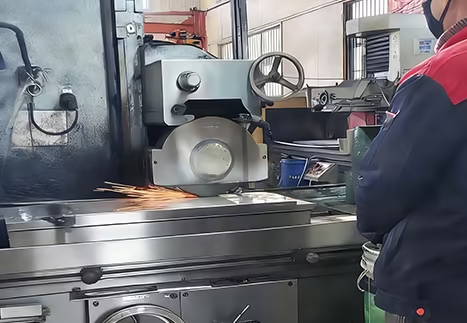
Surface grinding
Used to create flat and highly accurate surfaces.
Cylindrical grinding
Used for shafts, rods, and rotating components.
Centerless grinding
Used for high-volume precision cylindrical parts.
Internal grinding
Used for machining internal diameters with high accuracy.
Each type serves a specific engineering purpose depending on geometry and tolerance requirements.
Materials Commonly Processed in Grinding Services
Grinding is particularly effective for hard and heat-treated materials:
- Hardened steel
- Stainless steel
- Tool steel
- Titanium alloys
- Ceramic-based materials
Because grinding relies on abrasion rather than cutting, it is ideal for materials that are difficult to machine conventionally.
Grinding vs Other Machining Processes
| Process | Purpose | Precision Level | Material Removal |
|---|---|---|---|
| Milling | Shape creation | High | Medium |
| Turning | Cylindrical shaping | High | High |
| Grinding | Final finishing | Very high | Very low |
Grinding is the only process focused primarily on achieving final tolerances and surface quality rather than bulk material removal.
Industrial Applications of Grinding Services
Aerospace engineering
Used for turbine components, shafts, and precision fittings.
Automotive manufacturing
Used for crankshafts, camshafts, and transmission parts.
Medical devices
Used for surgical tools and implant components.
Industrial machinery
Used for bearings, rollers, and high-load mechanical systems.
These applications require extreme precision and long-term durability.
Surface Finish and Accuracy Achieved Through Grinding
Grinding can achieve some of the finest surface finishes in manufacturing.
Typical surface roughness ranges:
- Rough grinding: Ra 1.6–3.2 μm
- Precision grinding: Ra 0.2–0.8 μm
- Ultra-precision grinding: below Ra 0.2 μm
According to machining process benchmarks referenced in manufacturing engineering literature, grinding is one of the most effective methods for achieving mirror-like surface finishes.
Quality Control in Grinding Services
Grinding requires strict inspection standards due to its precision nature.
Common inspection methods include:
- Coordinate Measuring Machines (CMM)
- Surface roughness testers
- Roundness measurement systems
- Non-destructive testing (NDT)
ISO machining quality standards emphasize surface integrity as a key factor in component reliability.
Common Challenges in Grinding Operations
Thermal damage
Excess heat can affect material properties.
Wheel wear
Abrasive wheel degradation impacts consistency.
Surface burns
Improper feed rates may damage surface integrity.
Vibration control
Machine stability is critical for precision grinding.
Cost and Efficiency Factors in Grinding Services
Grinding efficiency depends on:
- Material hardness
- Required tolerance level
- Surface finish requirements
- Production volume
- Pre-machining quality
Grinding is typically used as a final step, meaning upstream machining quality directly impacts efficiency.
How to Choose the Right Grinding Services Provider
When evaluating grinding services, consider:
- Precision machining capability
- Inspection systems and quality control
- Material expertise
- Experience with high-tolerance components
- Consistency in finishing accuracy
You can explore grinding capabilities here:
👉 Grinding Services
Final Insight
Grinding services represent the final stage of precision manufacturing where geometry is refined, surfaces are perfected, and functional reliability is ensured. While earlier machining processes define shape, grinding defines performance.
For industries where precision and durability cannot be compromised, grinding is not just an option—it is a critical requirement.
FAQ
What are grinding services used for?
They are used to achieve high-precision surface finishing and tight dimensional tolerances.
Why is grinding needed after machining?
Because it refines surfaces and corrects minor dimensional deviations.
What materials can be ground?
Hardened metals, stainless steel, titanium, and ceramics.
How accurate is grinding?
It can achieve micron-level accuracy depending on setup.
Is grinding the final manufacturing step?
Yes, it is typically the final finishing process in precision machining.
Latest News
Contact Us
FAQ
What types of parts can be machined?
We can machine a wide range of high-precision CNC parts for automotive, aerospace, medical devices, industrial machinery, and automation equipment, including complex geometries and custom non-standard parts.
What is the machining accuracy?
We can achieve high-precision machining with ±0.005mm tolerance and ensure consistent quality through our strict quality control system.
Can you provide small-batch and prototype manufacturing services?
Yes, we support small-batch production and prototype machining, with flexible scheduling to meet urgent client requirements.
Do you offer customized processing solutions?
Yes, we provide customized solutions with one-on-one technical support, from design review and process optimization to final machining.
How long does delivery usually take?
Delivery time depends on part complexity and quantity, typically within 1-6 weeks. We provide a detailed schedule upon order confirmation.
What certifications are available for quality management systems?
We hold ISO 9001, ISO 14001, and ISO 45001 certifications, strictly following international quality, environmental, and safety standards.
How long does delivery usually take?
Delivery time depends on part complexity and quantity, typically within 1-6 weeks. We provide a detailed schedule upon order confirmation.