
Top Benefits of Precision Machine Fabrication in Industrial Engineering
Home
/
Blog
/
Top Benefits of Precision Machine Fabrication in Industrial Engineering
Top Benefits of Precision Machine Fabrication in Industrial Engineering
May 26, 2026
In modern industrial engineering, performance is no longer defined only by how strong a component is, but by how precisely it is manufactured, how consistently it performs, and how efficiently it can be reproduced at scale. This is where precision machine fabrication becomes a critical foundation of modern production systems.
Whether you are developing aerospace structures, industrial automation systems, or medical-grade components, precision fabrication directly influences product reliability, manufacturing cost, and long-term operational stability. In many engineering environments, even a small deviation in dimensional accuracy can lead to performance loss or system failure.
This article breaks down the real benefits of precision machine fabrication, supported by manufacturing principles, engineering insights, and industry-backed observations. The goal is to help you understand not just what it is, but why it matters in real production decisions.
Table of Contents
What Is Precision Machine Fabrication?

Precision machine fabrication refers to the integrated manufacturing process that combines CNC machining, cutting, forming, welding, finishing, and inspection to produce highly accurate components with tight tolerances.
Unlike general fabrication, which may focus on structural assembly, precision machine fabrication emphasizes dimensional accuracy, repeatability, and surface integrity.
In practical terms, it ensures that every part you produce matches the design model within extremely tight tolerance ranges, often measured in microns depending on application requirements.
According to manufacturing engineering references such as SME (Society of Manufacturing Engineers), precision fabrication is a key enabler of modern high-performance industrial systems because it reduces variability across production cycles.
Core Processes in Precision Machine Fabrication
Precision machine fabrication is not a single operation but a structured workflow that combines multiple advanced processes:
- CNC milling and turning for shaping components
- Laser or mechanical cutting for raw material preparation
- Welding and structural assembly for integration
- Grinding and finishing for surface refinement
- Dimensional inspection for quality verification
Each step contributes to the final accuracy and functionality of the component. If any stage is poorly controlled, the entire system can lose precision.
You can explore related processes here:
CNC Machining Services
CNC Turning Services
Grinding Services
High Dimensional Accuracy
One of the most important advantages of precision machine fabrication is its ability to achieve extremely tight dimensional tolerances.
Modern CNC-based fabrication systems can consistently maintain accuracy levels within very small deviation ranges depending on machine setup, tooling, and material behavior.
Industry machining studies indicate that precision CNC systems can reduce dimensional variation by a significant margin compared to conventional manual processes, especially in multi-step production workflows.
This level of accuracy is critical when components must fit into complex assemblies where even minor misalignment can cause mechanical failure.
Superior Material Efficiency
Precision fabrication is not just about accuracy—it also improves material utilization.
Because machining paths are digitally optimized, material waste is significantly reduced compared to traditional manufacturing methods.
Key advantages include:
- Reduced raw material scrap
- Optimized cutting strategies
- Lower rework rates
- Improved sustainability outcomes
Manufacturing efficiency reports from industrial engineering studies consistently show that optimized CNC-based fabrication can reduce material waste by 10–30% depending on geometry complexity and production scale.
Consistency and Repeatability
In industrial production, consistency is often more important than single-part precision.
Precision machine fabrication ensures that every part produced matches the same dimensional and structural standards.
This is achieved through:
- Automated CNC programming
- Controlled toolpaths
- Standardized machining parameters
- Real-time process monitoring
This repeatability is essential in industries where thousands of identical components must perform reliably under the same operating conditions.
Ability to Produce Complex Geometries
Modern engineering designs are becoming more complex, requiring advanced manufacturing capability.
Precision machine fabrication supports:
- Multi-axis machining of intricate geometries
- Deep cavities and internal features
- Thin-walled structures
- Non-standard surface profiles
Without precision fabrication, many modern product designs would simply be impossible to manufacture at scale.
Faster Production Efficiency
Precision fabrication systems reduce production time through optimized workflows.
This includes:
- Reduced setup operations
- Multi-process machining in a single cycle
- Automated tool switching
- Streamlined inspection procedures
Fewer interruptions between steps lead to faster production cycles and more efficient manufacturing throughput.
Improved Structural Integrity
Precision fabrication also improves the mechanical performance of components.
By controlling machining stress, heat input, and material deformation, the final product exhibits:
- Better fatigue resistance
- Higher load-bearing stability
- Reduced micro-defects
- Improved long-term durability
This is especially important in structural and high-load applications.
Wide Material Compatibility
Precision machine fabrication supports a wide range of engineering materials:
| Material Type | Common Use | Key Advantage |
|---|---|---|
| Aluminum alloys | Lightweight structures | High machinability |
| Stainless steel | Corrosion-resistant parts | Durability |
| Titanium alloys | Aerospace and medical components | High strength-to-weight ratio |
| Engineering plastics | Insulation and lightweight parts | Chemical stability |
Each material requires different machining strategies, tool selections, and cutting parameters to maintain precision and surface quality.
Industrial Applications of Precision Machine Fabrication
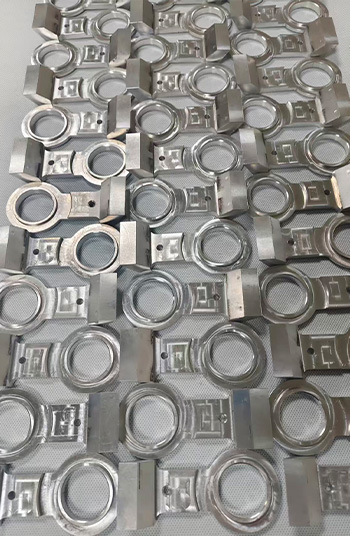
Precision machine fabrication is widely used across multiple industries:
Aerospace engineering
Used for structural components, housings, and high-precision assemblies.
Automotive systems
Used in drivetrain components, engine parts, and structural brackets.
Medical manufacturing
Used for surgical instruments and implant-grade components.
Industrial automation
Used for machine frames, robotic parts, and precision mechanisms.
Energy systems
Used in turbine components and high-load mechanical assemblies.
These industries require consistent accuracy and reliability across large production volumes.
Precision Machine Fabrication vs Conventional Fabrication
| Factor | Precision Machine Fabrication | Conventional Fabrication |
|---|---|---|
| Accuracy | High (micron-level possible) | Moderate |
| Repeatability | Very high | Variable |
| Automation level | High | Low to medium |
| Material waste | Lower | Higher |
| Complexity capability | Advanced geometries | Limited |
This comparison shows why precision fabrication is increasingly replacing traditional methods in high-performance industries.
Quality Control and Inspection Systems
Quality assurance is a core part of precision machine fabrication.
Common inspection methods include:
- Coordinate Measuring Machines (CMM)
- Optical measurement systems
- Surface roughness testing
- Non-destructive evaluation methods
According to ISO quality management principles, structured inspection processes are essential to ensuring repeatability and reliability in industrial manufacturing systems.
Future Trends in Precision Machine Fabrication
The future of precision fabrication is shaped by:
- AI-driven machining optimization
- Smart manufacturing and IoT integration
- Hybrid additive + subtractive systems
- Sustainability-focused production models
Industry research suggests that intelligent manufacturing systems will significantly reduce production errors and improve efficiency in complex fabrication environments.
How to Choose the Right Precision Machine Fabrication Partner
When selecting a service provider, you should evaluate:
- Technical machining capability
- Quality control systems
- Material processing experience
- Engineering support quality
- Production scalability
A strong partner does not only manufacture parts but also helps optimize the design for better manufacturability.
Final Insight
Precision machine fabrication is not just a manufacturing method—it is a foundation of modern industrial engineering. It enables engineers to move from conceptual design to real-world production with confidence in accuracy, consistency, and performance.
As industries continue to demand higher efficiency and tighter tolerances, precision fabrication will remain a core driver of innovation and manufacturing competitiveness.
FAQ
What is precision machine fabrication used for?
It is used to produce highly accurate and complex industrial components.
How accurate is precision machine fabrication?
It can achieve micron-level precision depending on process and equipment.
What materials are used?
Metals, alloys, and engineering plastics are commonly used.
What industries rely on it?
Aerospace, automotive, medical, and industrial engineering sectors.
What is the main benefit?
High accuracy, repeatability, and ability to produce complex parts efficiently.
Latest News
Contact Us
FAQ
What types of parts can be machined?
We can machine a wide range of high-precision CNC parts for automotive, aerospace, medical devices, industrial machinery, and automation equipment, including complex geometries and custom non-standard parts.
What is the machining accuracy?
We can achieve high-precision machining with ±0.005mm tolerance and ensure consistent quality through our strict quality control system.
Can you provide small-batch and prototype manufacturing services?
Yes, we support small-batch production and prototype machining, with flexible scheduling to meet urgent client requirements.
Do you offer customized processing solutions?
Yes, we provide customized solutions with one-on-one technical support, from design review and process optimization to final machining.
How long does delivery usually take?
Delivery time depends on part complexity and quantity, typically within 1-6 weeks. We provide a detailed schedule upon order confirmation.
What certifications are available for quality management systems?
We hold ISO 9001, ISO 14001, and ISO 45001 certifications, strictly following international quality, environmental, and safety standards.
How long does delivery usually take?
Delivery time depends on part complexity and quantity, typically within 1-6 weeks. We provide a detailed schedule upon order confirmation.