
Precision CNC Machining: How Tight Tolerances Are Achieved
Home
/
Blog
/
Precision CNC Machining: How Tight Tolerances Are Achieved
Precision CNC Machining: How Tight Tolerances Are Achieved
February 11, 2026
Table of Contents
If you are sourcing high-performance components today, you are likely facing increasing pressure to achieve tighter tolerances, better repeatability, and more consistent surface quality — all while controlling cost and lead time. Precision CNC machining sits at the center of this challenge. It is no longer just about shaping metal or plastic into parts; it is about controlling microns, managing thermal behavior, and ensuring that every feature works together as part of a complete functional system.
When you specify tight tolerances, you are not just demanding accuracy from a machine. You are relying on a complete ecosystem: material selection, machine stability, tooling strategy, cutting parameters, inspection systems, and even environmental control. Understanding how these elements work together helps you design better parts, choose the right manufacturing approach, and avoid unnecessary cost drivers.
In this guide, you will learn how tight tolerances are realistically achieved in precision CNC machining, what factors influence dimensional accuracy, and how you can actively improve outcomes during design and production planning.
Why Precision CNC Machining Tight Tolerances Matter More Than Ever
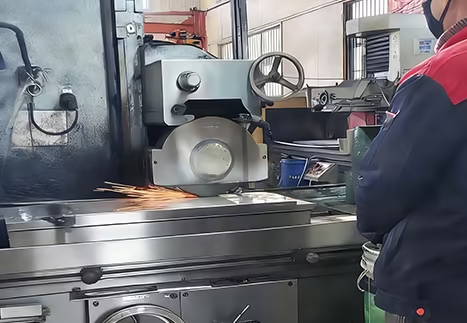
Modern product design is pushing toward smaller assemblies, higher load efficiency, and integrated multi-function components. As a result, tolerance stacking is becoming more critical. If a single dimension drifts outside specification, it can affect sealing performance, vibration behavior, or mechanical alignment.
You may be working on assemblies where multiple machined components interact. In these situations, tolerance is not just a quality metric — it is a functional requirement. A bearing seat that is too loose or too tight can change heat generation, lubrication behavior, and overall lifespan.
Precision machining allows you to control these variables at scale, which is why industries requiring high reliability increasingly depend on advanced CNC manufacturing methods.
What “Tight Tolerance” Really Means in Precision CNC Machining
Tolerances vary widely depending on part size, geometry, and material. In general production machining, tolerances of ±0.05 mm may be acceptable. In precision CNC machining, you are often targeting:
| Precision Level | Typical Tolerance Range |
|---|---|
| Standard Machining | ±0.05 mm |
| High Precision Machining | ±0.01 mm |
| Ultra Precision Machining | ±0.002 – ±0.005 mm |
Achieving tighter tolerances requires significantly more process control. As tolerances shrink, machining becomes less forgiving to vibration, tool wear, and thermal expansion.
The Foundation: Machine Tool Stability
If you want consistent precision, machine stability is the starting point. Even the most advanced programming cannot compensate for mechanical instability.
High-precision machining centers typically feature:
- High-rigidity cast structures
- Thermal compensation systems
- High-resolution encoders
- Precision spindle assemblies
- Vibration damping design
If machine deflection changes during cutting, dimensional accuracy will drift. That is why precision machining facilities often invest heavily in machine calibration and maintenance schedules.
Thermal Control: The Hidden Factor Behind Accuracy
Thermal expansion is one of the biggest hidden challenges in precision machining. Even small temperature changes can affect part dimensions.
For example, if you are machining aluminum and the temperature increases by just a few degrees, the material can expand enough to affect micron-level tolerances.
Precision machining environments often use:
- Climate-controlled production areas
- Warm-up cycles for machines
- Controlled coolant temperature
- Process timing to maintain consistency
If you are specifying ultra-tight tolerances, environmental control is often just as important as machine capability.
Tooling Strategy: More Than Just Cutting Tools
You might assume tooling only affects cutting speed and surface finish, but in precision machining, tooling directly influences dimensional stability.
Key tooling considerations include:
- Tool material stability at temperature
- Tool coating to reduce friction
- Tool runout control
- Tool wear monitoring
If tool wear is not tracked correctly, dimensional drift can occur gradually across a production batch.
Real-World Case Study: Precision Valve Component

Imagine you are manufacturing a high-pressure valve body with the following requirements:
- Sealing bore tolerance: ±0.005 mm
- Concentricity requirement: 0.008 mm
- Surface finish: Ra < 0.8 µm
Initial Production Challenge
Early production showed:
- Bore size drifting after 20 parts
- Surface finish variation near tool end of life
- Slight concentricity variation after re-fixturing
Precision CNC Machining Solution
Process improvements included:
- In-process tool wear measurement
- Reduced tool engagement strategy
- Controlled coolant temperature
- Single-setup machining strategy
Result:
- Bore size variation reduced by 60%
- Surface finish stabilized
- Scrap rate reduced significantly
Workholding: The Often Overlooked Precision Factor
If your part moves even slightly during machining, tolerance accuracy is immediately compromised.
Precision workholding strategies include:
- Custom soft jaws matched to part geometry
- Vacuum fixtures for thin-wall parts
- Multi-contact clamping to distribute stress
- Torque-controlled clamping procedures
For thin-walled or delicate parts, improper clamping can cause deformation during machining.
Cutting Parameters and Process Optimization
Precision machining requires careful balance between cutting force and material removal efficiency.
Common precision strategies include:
- Lower radial engagement
- Higher spindle speeds with lighter cuts
- Controlled chip evacuation
- Constant tool engagement toolpaths
These methods reduce cutting force variation, which improves dimensional consistency.
The Role of Multi-Axis Machining in Precision Work
Multi-axis machining often improves precision by reducing the number of setups required. Each time a part is repositioned, small alignment variations can occur.
If your part requires multiple angled features, multi-axis machining can maintain datum relationships more effectively.
Inspection and Measurement Technology
Achieving tight tolerances is impossible without advanced inspection systems.
Modern precision manufacturing uses:
- Coordinate measuring machines (CMM)
- In-process probing
- Laser measurement systems
- Statistical process monitoring
Measurement is not just final verification — it is part of the production process.
Statistical Process Control and Consistency
If you are planning production runs, statistical process monitoring becomes essential.
Instead of measuring only final parts, precision machining facilities monitor dimensional trends. This allows early detection of tool wear or process drift.
Material Selection and Its Impact on Precision
Different materials behave differently during machining.
| Material Type | Precision Challenge |
|---|---|
| Aluminum Alloys | Thermal expansion sensitivity |
| Stainless Steel | Work hardening risk |
| Titanium Alloys | Heat concentration |
| Tool Steels | Tool wear acceleration |
Choosing the right material grade can significantly improve machining stability.
Design Tips to Help Achieve Tight Tolerances
If you want to reduce manufacturing risk, consider:
- Avoid unnecessarily tight tolerances
- Maintain consistent wall thickness
- Provide clear datum references
- Avoid deep narrow cavities when possible
- Specify functional tolerances instead of cosmetic ones
Design for manufacturability is one of the most effective cost control tools.
Cost Reality of Tight Tolerances
Tolerance cost is not linear. Each step tighter increases process complexity significantly.
| Tolerance Range | Relative Cost Impact |
|---|---|
| ±0.05 mm | Baseline |
| ±0.01 mm | +40–80% |
| ±0.005 mm | +100–200% |
| ±0.002 mm | Specialty process level |
Understanding this helps you balance performance and cost.
Lead Time Considerations
Tighter tolerances often increase:
- Programming time
- Setup validation
- Inspection frequency
- Tool management complexity
Planning for this early prevents timeline surprises.
Future Trends in Precision CNC Machining
Precision machining is moving toward:
- Real-time tool wear monitoring
- AI-assisted toolpath optimization
- Closed-loop machining with measurement feedback
- Digital twin machining simulation
These technologies will continue to improve achievable tolerance consistency.
Conclusion
Precision CNC machining is not defined by machines alone. It is defined by how well every part of the manufacturing process is controlled. When you understand how tolerance is achieved — not just specified — you can make better engineering decisions, reduce production risk, and achieve more reliable product performance.
If you approach tight tolerance manufacturing strategically, you can achieve precision without unnecessary cost. The key is understanding where precision truly matters and designing your manufacturing strategy around it.
FAQ
What tolerance can precision CNC machining realistically achieve?
For most industrial parts, ±0.01 mm is achievable. Ultra precision applications may reach ±0.002 mm under controlled conditions.
Does tighter tolerance always improve part performance?
Not always. Only tighten tolerances when they affect function, fit, or safety.
How can I reduce cost when tight tolerances are required?
Focus tight tolerances only on functional features and allow standard tolerances elsewhere.
Does multi-axis machining improve precision?
Often yes, because it reduces setups and maintains datum relationships more consistently.
How important is inspection in precision CNC machining?
Inspection is critical. Without advanced measurement, tight tolerance machining cannot be maintained consistently.
What is the biggest risk to precision CNC machining accuracy?
Thermal variation, tool wear, and improper workholding are among the most common risks.
Latest News
Contact Us
FAQ
What types of parts can be machined?
We can machine a wide range of high-precision CNC parts for automotive, aerospace, medical devices, industrial machinery, and automation equipment, including complex geometries and custom non-standard parts.
What is the machining accuracy?
We can achieve high-precision machining with ±0.005mm tolerance and ensure consistent quality through our strict quality control system.
Can you provide small-batch and prototype manufacturing services?
Yes, we support small-batch production and prototype machining, with flexible scheduling to meet urgent client requirements.
Do you offer customized processing solutions?
Yes, we provide customized solutions with one-on-one technical support, from design review and process optimization to final machining.
How long does delivery usually take?
Delivery time depends on part complexity and quantity, typically within 1-6 weeks. We provide a detailed schedule upon order confirmation.
What certifications are available for quality management systems?
We hold ISO 9001, ISO 14001, and ISO 45001 certifications, strictly following international quality, environmental, and safety standards.
How long does delivery usually take?
Delivery time depends on part complexity and quantity, typically within 1-6 weeks. We provide a detailed schedule upon order confirmation.