
Why Welded Structural Component Processing Services Are Critical for Modern Industrial Engineering
Home
/
Blog
/
Why Welded Structural Component Processing Services Are Critical for Modern Industrial Engineering
Why Welded Structural Component Processing Services Are Critical for Modern Industrial Engineering
May 26, 2026
In modern engineering and industrial manufacturing, welded structural components are the backbone of load-bearing systems. From machinery frames to infrastructure supports and industrial enclosures, welded assemblies define the strength, stability, and long-term performance of engineered products.
However, what many overlook is that welding alone is not enough. The real value comes from welded structural component processing services, which ensure dimensional accuracy, structural integrity, stress control, and long-term durability after welding is completed.
This article explores how welded structural component processing services work, why it is essential in precision manufacturing, and how it impacts performance in real engineering environments.
You can also explore related manufacturing capabilities here:
👉 What Is CNC Machining?
👉 CNC Machining Tolerances: What You Should Specify and Why
👉 Machinist Services Explained: Skills & Manufacturing Role
Table of Contents
What Welded Structural Component Processing Services Actually Mean
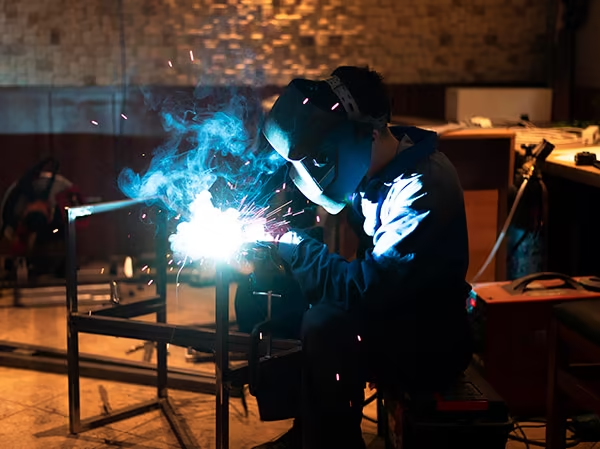
Welded structural component processing services refers to the full post-welding engineering workflow that transforms raw welded assemblies into precision, functional, and stable structural components.
It includes not only welding but also:
- Stress relief and deformation correction
- Precision machining of welded assemblies
- Alignment and geometric correction
- Surface finishing and corrosion protection
- Dimensional inspection and validation
According to manufacturing standards referenced in AWS (American Welding Society) guidelines, welded structures must undergo controlled post-processing to ensure they meet mechanical and safety performance requirements.
Without proper processing, welded structures may suffer from distortion, residual stress, and long-term fatigue failure.
Why Welding Alone Is Not Enough for Structural Components
When metal is welded, it undergoes intense localized heating and rapid cooling. This creates internal stress and potential deformation.
Common issues without post-processing:
- Warping and geometric distortion
- Uneven load distribution
- Reduced fatigue resistance
- Misalignment in assembly structures
- Poor dimensional repeatability
Industry engineering studies published in materials science journals show that residual welding stress can reduce fatigue life significantly if not properly relieved or corrected.
This is why welded structural component processing services are critical in precision manufacturing systems.
Full Workflow of Welded Structural Component Processing
Step 1: Structural welding and assembly
Components are initially welded using MIG, TIG, or arc welding depending on material type and structural requirements.
Step 2: Stress analysis and deformation assessment
Engineers evaluate structural distortion caused by heat input during welding.
Step 3: Stress relief treatment
Thermal or mechanical stress relief methods are applied to stabilize the structure.
Step 4: Precision machining of welded parts
CNC machining is used to restore critical tolerances on welded surfaces.
Related processes:
👉 CNC Machining
👉 CNC Turning Services
Step 5: Alignment correction and assembly verification
Geometric accuracy is checked and adjusted to ensure structural consistency.
Step 6: Surface finishing and protection
Processes such as coating or treatment improve corrosion resistance and durability.
Key Benefits of Welded Structural Component Processing Services
Improved structural stability
Post-processing reduces internal stress, improving long-term mechanical stability.
Higher dimensional accuracy
Machining after welding restores precision on key functional surfaces.
Enhanced fatigue resistance
Stress-relief processes significantly improve lifecycle performance.
Better load distribution
Corrected geometry ensures uniform force distribution across structures.
Increased assembly reliability
Processed components fit together more accurately in complex assemblies.
Materials Commonly Used in Welded Structural Components
Welded structural processing applies to a wide range of industrial materials:
- Carbon steel for heavy-load structures
- Stainless steel for corrosion-resistant environments
- Aluminum alloys for lightweight frameworks
- High-strength low-alloy steels for industrial machinery
Each material responds differently to heat input, which affects distortion levels and post-processing requirements.
Applications Across Industrial Sectors
Heavy machinery and equipment frames
Used for structural bases, machine housings, and load-bearing frameworks.
Construction and infrastructure systems
Applied in steel frameworks, support structures, and modular assemblies.
Automotive manufacturing
Used in chassis structures, brackets, and reinforcement systems.
Energy and industrial systems
Applied in turbine housings, support structures, and pressure systems.
These applications require not only strength but also high dimensional consistency after welding.
Welding Distortion and How It Is Controlled
Thermal deformation mechanisms
Welding heat causes expansion and contraction, leading to structural bending.
Control strategies include:
- Balanced welding sequences
- Preheating and controlled cooling
- Fixture-based alignment systems
- Post-weld machining corrections
Engineering research published in welding technology journals highlights that controlled sequencing can reduce distortion by up to 30–50% depending on material thickness and geometry.
Role of CNC Machining in Welded Component Processing
CNC machining plays a critical role after welding by restoring precision surfaces.
It is commonly used for:
- Flatness correction
- Hole alignment
- Surface finishing
- Assembly interface refinement
This hybrid approach (welding + machining) is widely recognized in modern manufacturing systems for achieving both strength and precision.
Inspection and Quality Control Methods
Quality assurance is essential in welded structural processing.
Common inspection techniques:
- Coordinate Measuring Machines (CMM)
- Ultrasonic testing for internal defects
- Visual weld inspection
- Dimensional verification systems
Standards from ISO 3834 and AWS guidelines emphasize strict inspection procedures for structural welding applications.
Cost and Efficiency Factors in Welded Structural Processing
While every project is different, key cost drivers include:
- Material type and thickness
- Welding complexity and geometry
- Post-weld machining requirements
- Inspection and quality standards
- Production volume
Efficiency improves significantly when welding and machining are designed together from the beginning rather than treated as separate steps.
Challenges in Welded Structural Component Processing
Geometric distortion control
Maintaining dimensional accuracy after welding remains a major engineering challenge.
Residual stress management
Improper stress distribution can lead to long-term structural failure.
Multi-process coordination
Welding, machining, and inspection must be tightly synchronized.
How to Choose the Right Processing Partner
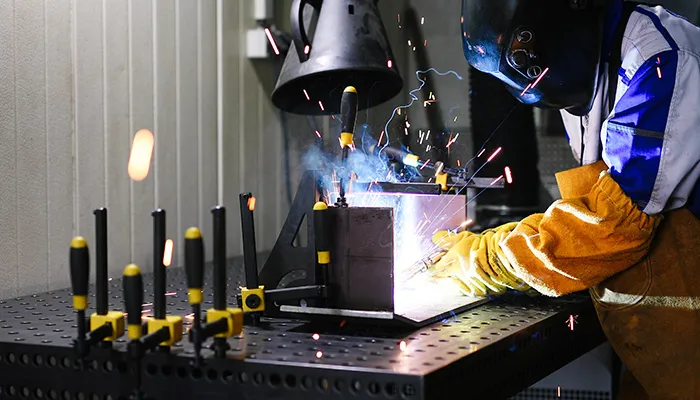
When selecting welded structural component processing services, you should evaluate:
- Welding engineering expertise
- CNC machining capability
- Quality control systems
- Experience with structural assemblies
- Ability to manage distortion control
You can explore related capabilities here:
👉 Welded structural component processing services
Final Insight
Welded structural component processing services are not just a finishing step—they are a critical engineering phase that determines whether a structure performs reliably under real-world conditions.
By combining welding expertise with precision machining and rigorous inspection, manufacturers can achieve strong, stable, and dimensionally accurate structural components suitable for demanding industrial applications.
FAQ
What are welded structural component processing services?
They include welding, post-weld machining, stress relief, and inspection to ensure structural accuracy and performance.
Why is post-weld processing necessary?
Because welding introduces heat distortion and internal stress that must be corrected.
What industries use welded structural processing?
Construction, automotive, industrial machinery, and energy systems.
Can welded parts be machined?
Yes, CNC machining is commonly used to restore precision surfaces after welding.
How is weld distortion controlled?
Through welding sequence optimization, stress relief, and post-processing machining.
Latest News
Contact Us
FAQ
What types of parts can be machined?
We can machine a wide range of high-precision CNC parts for automotive, aerospace, medical devices, industrial machinery, and automation equipment, including complex geometries and custom non-standard parts.
What is the machining accuracy?
We can achieve high-precision machining with ±0.005mm tolerance and ensure consistent quality through our strict quality control system.
Can you provide small-batch and prototype manufacturing services?
Yes, we support small-batch production and prototype machining, with flexible scheduling to meet urgent client requirements.
Do you offer customized processing solutions?
Yes, we provide customized solutions with one-on-one technical support, from design review and process optimization to final machining.
How long does delivery usually take?
Delivery time depends on part complexity and quantity, typically within 1-6 weeks. We provide a detailed schedule upon order confirmation.
What certifications are available for quality management systems?
We hold ISO 9001, ISO 14001, and ISO 45001 certifications, strictly following international quality, environmental, and safety standards.
How long does delivery usually take?
Delivery time depends on part complexity and quantity, typically within 1-6 weeks. We provide a detailed schedule upon order confirmation.