
Resin Casting for Faster Prototype and Low-Volume Part Development
Home
/
Blog
/
Resin Casting for Faster Prototype and Low-Volume Part Development
Resin Casting for Faster Prototype and Low-Volume Part Development
August 19, 2026
Table of Contents
Introduction
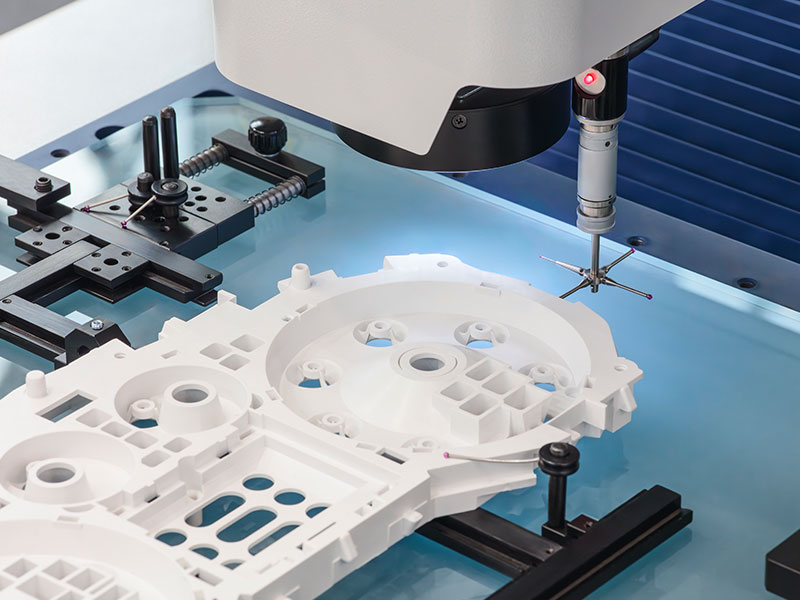
Resin casting provides a practical way to transform a master model or mold into detailed polymer components without relying entirely on subtractive machining for every surface. For prototypes, custom components and low-volume manufacturing, the process can reproduce complex external geometry, fine surface details and integrated features while giving designers considerable flexibility in material selection and part development.
However, successful resin casting involves more than pouring a liquid material into a mold and waiting for it to harden. Resin type, mixing accuracy, mold design, air entrapment, wall thickness, curing behavior, shrinkage, temperature and post-processing all influence the finished component. A part can reproduce the shape of a mold accurately while still developing bubbles, dimensional changes, incomplete filling or surface defects if these variables are not controlled.
From a manufacturing perspective, the most useful way to understand resin casting is as a complete process that begins with the master pattern and ends with inspection and finishing. Mold quality determines what geometry can be reproduced, material behavior determines how the cavity fills and cures, and post-processing determines whether critical interfaces meet their final functional requirements.
This guide explains how resin casting works, which materials and design factors matter, how common defects can be controlled and where machining, mold manufacturing and quality inspection fit into a reliable production strategy.
What Is Resin Casting?
Resin casting is a plastic casting process in which a liquid synthetic resin is introduced into a mold and then allowed to cure into a solid component. Depending on the resin system, hardening occurs through a chemical reaction after the material is mixed with a curing agent or another reactive component.
Unlike machining, which creates geometry by removing material from a solid workpiece, resin casting reproduces the shape already formed inside the mold cavity. This makes mold accuracy especially important because every radius, texture, draft condition and surface feature in the mold can influence the final casting.
The process can use several types of synthetic resin, including polyurethane, epoxy, polyester and other thermosetting systems. These materials do not behave identically during pouring and curing, so the correct resin should be selected according to mechanical requirements, dimensional expectations, surface quality, processing conditions and the intended function of the finished part.
For manufacturing engineers, resin casting should therefore be viewed as a material-and-mold system rather than simply a replication technique. A well-designed mold cannot compensate for an unsuitable resin, while a high-quality material cannot reproduce geometry consistently when the master and mold are poorly controlled.
Why Resin Casting Works Well for Prototype Development
One of the main advantages of resin casting is its ability to reproduce a developed master model without machining every individual component from solid polymer material. Once the master and mold have been prepared correctly, multiple parts can be produced with similar external geometry, making the process useful when designers need physical components for fit checks, functional evaluation, assembly development or design validation.
This is particularly useful for geometries that contain curved surfaces, decorative details, recessed areas or integrated shapes that would require several machining operations if produced directly from stock material. Casting transfers much of this geometric complexity into the mold, allowing the curing resin to reproduce the form during each cycle.
Prototype development also benefits from the ability to revise the master before committing to a more established manufacturing route. If an early component reveals an assembly problem, wall-thickness issue or difficult interface, the design can be adjusted and a revised master produced. In this sense, resin casting can form part of an iterative engineering workflow rather than functioning only as a final production method.
The important limitation is that a prototype should not be evaluated only by visual similarity. Dimensional stability, mechanical behavior and long-term performance depend on the selected resin and curing conditions. A prototype that looks correct may not necessarily represent the behavior of a component made from another material in later production.
Resin Selection Determines More Than Part Appearance
Choosing the resin is one of the most important decisions in the complete resin casting process because the material affects flow, curing behavior, hardness, flexibility, dimensional stability and the conditions under which the part can be processed after demolding.
Polyurethane resin systems are often associated with prototype and model casting because formulations can provide different combinations of rigidity and processing behavior. Epoxy systems are also used where their adhesive characteristics, dimensional behavior or compatibility with particular applications make them suitable. Other resin families can offer different surface, mechanical or processing characteristics.
The choice should begin with function rather than appearance. A rigid enclosure, flexible protective component and dimensional prototype have different performance requirements even if their external geometry is similar. Material properties should therefore be matched to loading, temperature exposure, contact conditions and expected service environment.
Machining requirements should also be considered. Some cured polymer materials may require drilling, trimming, sanding or other finishing operations after casting. If a component contains precision holes or mating surfaces, the selected resin needs to support those secondary processes without unnecessary cracking, edge damage or dimensional instability.
Apex’s work with engineering plastics and resin-based materials illustrates why material behavior should be considered together with downstream processing. The manufacturing route should be selected according to the actual material condition rather than assuming all polymer-based materials respond identically to machining.
Mold Quality Defines the Starting Accuracy of Resin Casting
The mold is effectively the geometric reference for a resin casting. If its surfaces contain unwanted marks, dimensional errors or damaged detail, those conditions can be transferred directly to the cast part. This makes mold development one of the most important stages of the process.
The workflow usually begins with a master pattern that represents the intended component geometry. The master may be produced using machining, additive manufacturing or another suitable process depending on the required detail and surface condition. A mold is then created around this master so that the negative cavity reproduces its shape.
Master quality therefore matters before the first resin is mixed. Surface irregularities that appear insignificant on the original can become visible on every subsequent casting. Likewise, features that are difficult to demold may damage the mold or finished component even when the CAD geometry itself is correct.
Mold design should also consider how resin enters the cavity and how displaced air leaves it. A closed region with no effective air-release path can trap bubbles or prevent complete filling. Parting-line position influences visible seams and later finishing, while mold flexibility affects how easily complex geometry can be released after curing.
For projects requiring custom molds or manufacturing fixtures, integrating tooling and mold manufacturing with the broader production plan can help establish more practical locating, forming and finishing strategies before repeated casting begins.
Mixing Accuracy Has a Direct Effect on Curing
Two-part resin systems depend on the correct relationship between the resin and its reactive component. Inaccurate mixing can alter curing behavior and create parts that remain soft, develop inconsistent mechanical properties or fail to reach the intended condition.
Mixing technique matters as much as proportion. Aggressive mixing can introduce additional air into the liquid. Once trapped, this air may remain as visible bubbles or internal voids after curing if it is not removed before or during mold filling.
The working time of the resin also needs to be considered. Once reactive components are combined, the material begins progressing toward cure. The operator therefore needs enough time to mix, manage air and fill the mold before viscosity increases to a level that restricts flow.
This creates an important process-development balance. Mixing needs to be thorough enough to create a uniform material while controlled enough to avoid unnecessary air introduction and delays. The most stable procedure is one that can be repeated consistently rather than relying on operators to improvise the mixing process for every casting.
Material instructions should always guide actual mixing and curing conditions because resin systems can differ significantly. A ratio, working time or curing method suitable for one formulation should not automatically be transferred to another.
Air Bubbles Are One of the Most Common Resin Casting Challenges
Air can enter resin during mixing and can also become trapped when liquid flows around complex geometry inside the mold. If this air remains during curing, the finished component may contain visible bubbles, internal voids or incomplete surface detail.
Bubble control therefore begins before the material enters the mold. Mixing should minimize unnecessary turbulence, while the mold should provide a filling path that does not repeatedly trap air in high points or enclosed features. Complex cavities may require more deliberate orientation so that air can move away as resin fills the available space.
Vacuum processing can be used with suitable resin systems to remove entrained air from mixed material before casting. Pressure techniques can also be used in appropriate workflows to reduce the visible effect of small bubbles. The correct method depends on material behavior, mold configuration and equipment.
Design geometry also influences bubble formation. Sharp pockets, narrow blind regions and complex internal details can create natural air traps. When these features are functionally necessary, mold orientation and venting become more important.
A useful quality strategy is to study where bubbles repeatedly occur rather than treating every defect as random. If voids consistently appear in the same area, the cause is likely related to flow direction, mold geometry or air evacuation and should be addressed at the process level.
Mold Filling Should Be Designed Around Flow Behavior
Liquid resin must reach every intended area of the mold before curing progresses too far. The filling process therefore depends on viscosity, cavity geometry, flow distance, mold orientation and the available escape path for air.
Large open cavities are generally easier to fill than narrow interconnected features. Thin sections can become more difficult when the resin begins to increase in viscosity before the cavity is completely filled, while abrupt changes in section geometry may influence how material flows through the mold.
Pouring location can affect this behavior. Introducing material without considering the geometry may cause resin to flow around an air pocket instead of displacing the air out of the mold. A more deliberate fill direction can allow the liquid level to rise progressively while pushing air toward vents or open regions.
The objective should be stable filling rather than simply rapid pouring. Filling too aggressively can introduce turbulence, while filling too slowly can become problematic when the resin has a limited working period.
For repeated manufacturing, the fill method should therefore be defined as part of the process. Mold orientation, pour location, material condition and handling method should remain reasonably consistent so that one casting is not produced under fundamentally different conditions from the next.
Curing Controls the Transition From Liquid to Finished Part
Curing is the stage in which the liquid resin develops into a solid polymer structure. Although the part may appear to be inactive while sitting in the mold, important physical and chemical changes are taking place during this period.
The curing reaction can generate heat, and the amount of heat produced depends on the resin system and quantity of material. Thick sections may behave differently from thin regions because larger volumes can retain more reaction heat. This can influence dimensional behavior, surface condition and the time required before the part is ready for safe demolding.
Removing the component too early can create deformation because the material may not yet have developed sufficient stability. Leaving the part in a poorly controlled curing environment can also introduce variation if temperature conditions differ substantially between production cycles.
For this reason, demolding time should not be determined only by whether the surface feels hard. The resin manufacturer’s specified curing conditions and the actual section geometry should be considered together.
Some materials also continue developing their final properties after initial demolding. When later machining or assembly requires dimensional stability, the production plan should account for the full curing condition rather than processing the part immediately simply because it can be removed from the mold.
Shrinkage and Dimensional Stability Need to Be Planned Early
Resin casting can reproduce detailed geometry, but designers should not assume that the cured component will match the mold cavity with perfect dimensional identity. Chemical curing and temperature changes can produce dimensional movement, and the amount depends on the specific material and part geometry.
Shrinkage becomes particularly important when several dimensions must maintain a controlled relationship. A general external cover may tolerate small dimensional changes without affecting function, while a precision insert location or mating interface may require a more deliberate strategy.
Part thickness can also influence dimensional behavior because different regions may cure and cool under different conditions. Large variations in section thickness can therefore create more complex dimensional changes than a relatively balanced design.
For prototype components, actual early castings provide useful process data. Instead of relying only on nominal CAD dimensions, the manufacturer can measure the finished parts and identify which features remain stable and which show systematic movement.
That information can then guide mold compensation, post-machining allowance or design revision. The objective is not to assume that shrinkage can be eliminated completely, but to understand how the chosen resin and geometry behave so the final process can account for predictable variation.
Wall Thickness Influences Both Filling and Curing
Wall thickness affects several stages of resin casting simultaneously. Very thin sections can make complete filling more difficult, especially when material viscosity increases quickly, while very thick regions can generate different thermal conditions during curing.
A balanced wall strategy can therefore improve process stability. This does not mean every region must have identical thickness, because functional features often require local reinforcement, mounting bosses or structural transitions. The goal is to avoid unnecessary extremes and abrupt changes that complicate flow and curing.
Ribs can sometimes provide stiffness without increasing an entire wall section. However, they should be designed with the mold and demolding process in mind rather than being added only because they appear structurally useful in CAD.
Local bosses also deserve attention. A large boss connected directly to a thin wall can create a significant difference in material volume between neighboring areas. A more gradual transition can sometimes produce more predictable curing behavior.
Resin casting design should therefore consider geometry as part of material processing. The same resin can behave differently when used in two components with substantially different wall structures.
Inserts Can Add Functional Features to Resin Castings
Some resin cast components require threads, mounting points or interfaces that are better provided by a separate insert than by the cured resin alone. Inserts can be positioned within the mold before casting so the resin cures around them and incorporates them into the finished component.
This approach can be useful when a metal interface, threaded attachment or localized reinforcement is required. However, successful insert integration depends on positioning accuracy and the relationship between the insert surface and resin.
The insert needs to remain stable while the mold is filled. If it moves during pouring, the final feature can shift from its intended location. Fixture or mold design should therefore support repeatable placement rather than relying on manual estimation.
Air can also become trapped around complex insert geometry. The flow path should allow resin to surround the feature without leaving voids in areas that need effective contact.
Material compatibility should also be considered. Different materials can respond differently to temperature and environmental conditions, while the interface needs to perform according to the mechanical requirements of the finished part.
Insert design is therefore a good example of why resin casting should be treated as an engineered assembly process rather than only a shape-replication method.
Resin Casting Defects Should Be Analyzed by Their Cause
Surface bubbles, internal voids, incomplete filling, soft areas, dimensional changes and visible mold seams are among the conditions that can appear in resin cast parts. Although several defects can exist on the same component, they should not automatically be treated as though they share one cause.
Bubbles can originate from air introduced during mixing or trapped during filling. An incompletely filled feature may indicate insufficient flow, inappropriate mold orientation or curing that advanced before the cavity was filled. Soft or inconsistent regions can point toward mixing or curing problems, while dimensional variation may involve resin shrinkage, mold movement or thermal conditions.
Surface defects can also originate from the master or mold rather than the resin itself. If the same mark appears on every casting, correcting the casting procedure will not solve a defect already built into the mold surface.
Root-cause analysis becomes much easier when production records identify material batch, mixing conditions, mold, cure conditions and defect location. Repeated patterns can then be connected to specific process variables instead of relying only on visual guesswork.
This approach improves both quality and repeatability because the objective changes from repairing individual castings to stabilizing the process that creates them.
Quality Control Should Cover the Complete Resin Casting Process
Quality control for resin casting should begin before the finished part is removed from the mold. Material condition, mixing accuracy, mold condition and process consistency all contribute to final quality, so inspection at only the last stage can miss the source of recurring problems.
The master and mold should first be checked for damage, contamination or dimensional conditions that could be transferred to the component. During material preparation, the mixing and filling procedure should remain consistent with the selected resin system. Once the part has cured, visual and dimensional inspection can evaluate the result according to its actual function.
Not every surface needs identical inspection attention. A cosmetic external face, a mating interface and an embedded mounting feature have different functional risks. Inspection should therefore focus more closely on characteristics that affect assembly, load transfer, sealing or dimensional positioning.
The following table summarizes the main variables that should be considered during resin casting development and production.
| Process Area | Main Risk | Practical Control Approach |
|---|---|---|
| Resin selection | Unsuitable material behavior | Match resin characteristics to part function and processing |
| Master pattern | Repeated geometric or surface errors | Verify master accuracy before mold production |
| Mold condition | Loss of detail or inconsistent surfaces | Inspect and maintain molds throughout repeated use |
| Mixing | Incomplete or inconsistent cure | Follow material-specific mixing requirements |
| Air control | Bubbles and internal voids | Reduce air introduction and manage degassing where appropriate |
| Mold filling | Incomplete features | Plan fill direction, mold orientation and air escape |
| Wall thickness | Uneven flow or curing | Avoid unnecessary thickness extremes |
| Curing | Deformation or inconsistent properties | Maintain suitable curing conditions before demolding |
| Shrinkage | Dimensional variation | Measure early parts and compensate where function requires |
| Inserts | Positioning or void problems | Locate inserts securely and consider resin flow around them |
| Post-processing | Damage to cured features | Match cutting and finishing methods to material behavior |
| Inspection | Undetected functional variation | Verify critical dimensions and interfaces after full cure |
A quality system becomes more useful when inspection findings are connected back to the relevant process stage rather than recorded only as final defects.
Post-Processing Turns Cast Geometry Into Functional Geometry
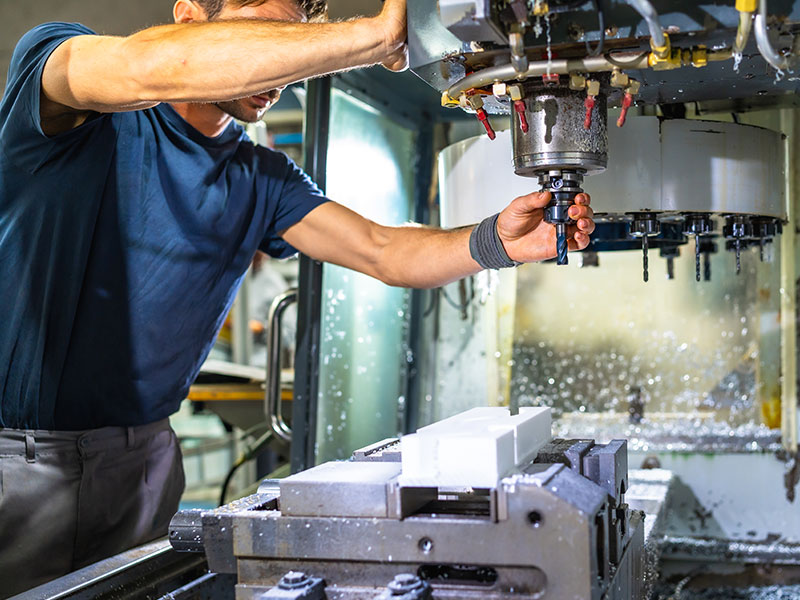
A resin cast component may require trimming, sanding, drilling, machining or assembly after removal from the mold. These operations are not necessarily signs that the casting process failed. Instead, they can be deliberately incorporated into the manufacturing route when certain features are better created after curing.
Parting lines and material associated with fill or vent locations may need to be removed. Holes may require finishing when their position or diameter needs greater control than the mold alone can provide. Mating faces can also require secondary processing when they directly influence assembly.
The challenge is to identify these requirements before the mold is designed. A surface intended for later machining may need suitable material allowance and a practical method of locating the cured component. If the casting has no stable reference surface, positioning it accurately during secondary machining can become difficult.
The resin itself must also be considered because cured polymer materials can respond differently to drilling and cutting than metals. Tool geometry, heat generation and workpiece support should match the material rather than applying a metal-machining strategy without adjustment.
In this way, casting and machining can complement each other. Resin casting creates complex near-net geometry, while selective secondary operations establish features that require additional dimensional control.
Resin Casting vs CNC Machining
Resin casting and CNC machining create components through fundamentally different routes. Casting forms material inside a mold, while CNC machining removes material from a solid workpiece. Neither method is automatically better for every component.
Resin casting can be attractive when a design contains complex molded geometry that can be replicated efficiently from a developed master and mold. It also supports iterative prototype and low-volume workflows where reproducing the same general form is important.
CNC machining provides direct control over selected dimensions and surfaces and can be highly effective when the component contains precision bores, planes, threads or other features that need controlled geometry. It also avoids the need to create a mold for every new design.
Some components benefit from using both approaches. Resin casting can establish the broad shape while machining creates final functional interfaces after the material has fully cured.
The correct decision therefore depends on geometry, material performance, dimensional requirements and expected manufacturing route. The question should not be whether casting or machining is universally superior, but which process should create each part feature most effectively.
Resin Casting vs Injection Molding
Resin casting and injection molding both use molds, but the manufacturing systems are different. Resin casting commonly introduces reactive liquid resin into a mold and allows the material to cure, while injection molding typically forces molten thermoplastic material into a durable mold under controlled machine conditions.
For prototype and lower-volume component development, resin casting can offer greater flexibility because the mold and process can be adapted around a developing design. Injection molding is better understood as a highly repeatable molding system suited to established component designs and repeated cycles.
Material behavior also differs. Thermosetting resin systems cure through chemical reactions and generally cannot simply be remelted into their original liquid state after curing. Thermoplastics used in injection molding soften when heated and solidify again during cooling.
These differences affect part design, tooling, processing and material selection. A component developed successfully through resin casting should therefore not automatically be assumed to behave identically if later transferred to another molding process.
When resin casting is used during development, engineers should separate geometry validation from final-material validation and consider how later production materials could change the component’s behavior.
From Master Pattern to Repeatable Resin Cast Parts
Producing one successful resin casting demonstrates that the mold and material can create the intended component. Producing the same result repeatedly requires a more controlled process.
Molds can change with use, mixing conditions can vary, ambient conditions can influence some resin systems and operators can introduce different amounts of air during material preparation. Repeated manufacturing therefore needs more consistency than a one-off prototype.
The first several parts should be treated as process-development evidence. Critical dimensions can be measured, recurring surface defects can be mapped and demolding behavior can be observed. If one area repeatedly traps air or changes dimension, the manufacturing route should be improved before the issue becomes accepted as normal variation.
Mold condition should also be monitored over time because flexible molds can gradually lose sharp details or become damaged during repeated demolding. A part produced late in a mold’s useful cycle may therefore differ from an early casting even when the material and procedure remain unchanged.
Repeatable resin casting comes from understanding these changing conditions and defining when molds, procedures or process controls need adjustment.
When Is Resin Casting a Suitable Manufacturing Choice?
Resin casting is particularly useful when the required component benefits from molded complex geometry, detailed surface reproduction and a manufacturing route suitable for prototypes or limited production. It can also support design validation when engineers need several physical copies of a developed master rather than a single machined prototype.
The process becomes less suitable when the required material performance cannot be achieved by an available resin or when critical dimensions depend on accuracy beyond what the selected mold-and-cure system can maintain without extensive secondary processing.
Part geometry also matters. Very thin sections, difficult air traps and large differences in wall thickness can increase process sensitivity. Designs containing many highly precise mechanical interfaces may require a hybrid route where casting establishes the shape and machining finishes selected features.
The best decision therefore comes from evaluating the complete finished component rather than choosing a process because the part looks moldable.
Engineers should consider material requirements, geometry, dimensional relationships, surface expectations, post-processing and inspection together. When these factors align with the strengths of the process, resin casting can be a practical tool for developing detailed and repeatable polymer components.
How to Evaluate a Resin Casting Process
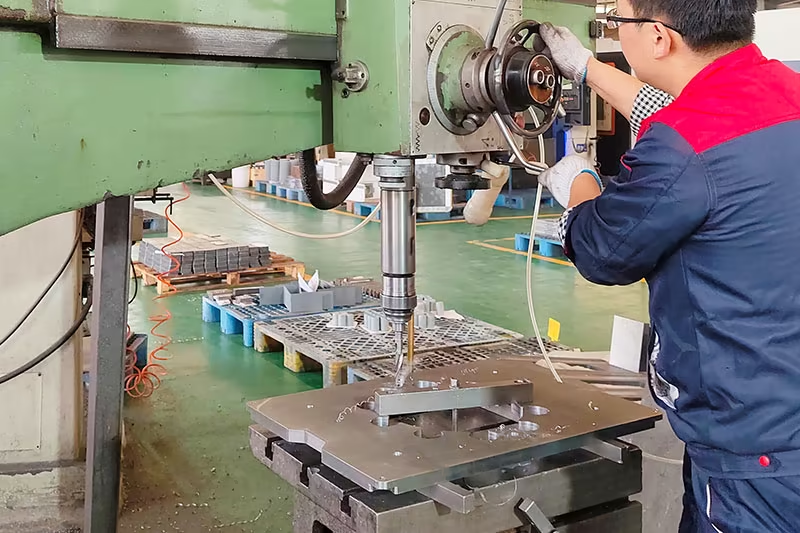
A reliable resin casting process should be evaluated through evidence rather than appearance alone. The first consideration is whether the chosen resin actually matches the functional requirements of the component. The second is whether the master and mold can reproduce the required geometry consistently. The third is whether mixing, filling and curing can be repeated without relying on uncontrolled manual adjustments.
Dimensional inspection should then focus on the features that matter to assembly. If several castings repeatedly move in the same direction, the variation should be studied as a process characteristic rather than treated as isolated measurement error.
Post-processing should also be included in the evaluation. A component that casts successfully but becomes difficult to trim, drill or machine may still require design changes. Likewise, an insert that repeatedly moves during filling indicates that fixture or mold design needs improvement.
The strongest process is therefore not the one that produces one visually perfect part. It is the one that provides a clear relationship between material preparation, mold behavior, curing conditions and verified finished-part performance.
Conclusion
Resin casting is an effective manufacturing method when complex polymer geometry needs to be reproduced from a developed master and mold, particularly during prototype development and controlled low-volume production. Its apparent simplicity can be misleading, however, because final quality depends on a network of interacting variables rather than the pouring operation alone.
Material selection influences flow, curing and finished performance. Mold quality determines the geometry and surface detail available to each casting. Mixing and filling affect air entrapment, while curing and wall thickness influence dimensional stability. Inserts, post-processing and inspection add further considerations when the finished component needs functional mechanical interfaces.
The most reliable approach is therefore to plan resin casting as a complete manufacturing route. Designers should identify which geometry can be created directly in the mold, which features may require secondary machining and which dimensions need to be verified after full cure.
Prototype parts should also be used to develop process knowledge. Repeated defects, shrinkage patterns and mold behavior provide useful information that can improve later production.
When mold design, material behavior, casting technique and finishing are controlled together, resin casting becomes more than a rapid replication method. It becomes a structured manufacturing process capable of producing detailed, functional and repeatable components.
FAQ
What is resin casting used for?
Resin casting is used to produce molded polymer components by curing liquid synthetic resin inside a prepared mold. It is particularly useful for prototypes, custom parts and limited production where complex geometry or detailed surfaces need to be reproduced from a master pattern without machining every surface from solid stock.
What materials are commonly used in resin casting?
Resin casting can use polyurethane, epoxy, polyester and other compatible synthetic resin systems. Each material has different flow, curing, hardness and dimensional characteristics, so the correct resin should be selected according to the part’s mechanical requirements, geometry and planned secondary processing.
How can bubbles be reduced in resin casting?
Bubble reduction begins with controlled mixing and mold design that allows displaced air to escape as resin fills the cavity. Depending on the resin and process, vacuum or pressure methods may also help manage trapped air. Repeated bubbles in one location usually indicate a filling, venting or geometry issue that should be corrected.
Does resin casting shrink during curing?
Some resin systems experience dimensional change as they cure, and the amount depends on material formulation, geometry and processing conditions. When dimensions are important, early castings should be measured after appropriate cure so predictable variation can be understood and addressed through mold design or post-processing.
Can resin casting parts be machined after curing?
Yes, some cured resin parts can be drilled, trimmed, sanded or machined when their material characteristics support those operations. Critical holes, mating faces or insert interfaces may be finished after casting, but tooling, support and heat generation should be selected according to the actual cured resin rather than metal-machining assumptions.
Latest News
Contact Us
FAQ
What types of parts can be machined?
We can machine a wide range of high-precision CNC parts for automotive, aerospace, medical devices, industrial machinery, and automation equipment, including complex geometries and custom non-standard parts.
What is the machining accuracy?
We can achieve high-precision machining with ±0.005mm tolerance and ensure consistent quality through our strict quality control system.
Can you provide small-batch and prototype manufacturing services?
Yes, we support small-batch production and prototype machining, with flexible scheduling to meet urgent client requirements.
Do you offer customized processing solutions?
Yes, we provide customized solutions with one-on-one technical support, from design review and process optimization to final machining.
How long does delivery usually take?
Delivery time depends on part complexity and quantity, typically within 1-6 weeks. We provide a detailed schedule upon order confirmation.
What certifications are available for quality management systems?
We hold ISO 9001, ISO 14001, and ISO 45001 certifications, strictly following international quality, environmental, and safety standards.
How long does delivery usually take?
Delivery time depends on part complexity and quantity, typically within 1-6 weeks. We provide a detailed schedule upon order confirmation.